Twin temple towns on the Yamuna, revered as the birthplace and childhood home of Krishna.
FamousPilgrimageHeritageRiverCity
Mathura is held to be the place where Krishna was born, and Vrindavan, its twin town, is one of the busiest Krishna pilgrimage centres in India. People come for temple darshan, the evening aarti on the Yamuna ghats and the Holi and Janmashtami festivals. It suits pilgrims, families and anyone who wants a short trip from Delhi or Agra, but expect crowds and narrow lanes.
Trip planner
Plan from your city
Photos
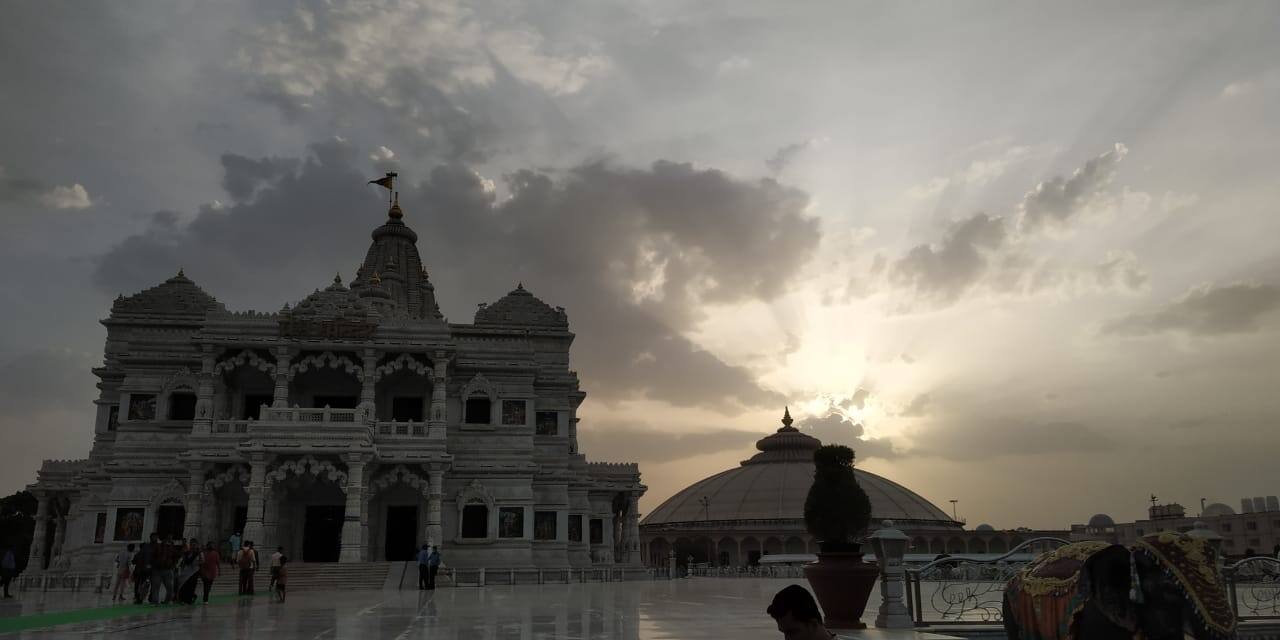
Prem Mandir, the white marble temple in VrindavanMain gate of Banke Bihari Temple, VrindavanMain gate of Prem Mandir, VrindavanRas Leela tableau in the grounds of Prem Mandir
Photos from Wikimedia Commons. Select a photo for its author and licence.
Best time to go
When
What to expect
October to March
The most comfortable months, with temperatures of about 10 to 25 degrees C. January nights can drop to about 5 degrees C. Holi in March is very crowded.
April to June
Very hot, often above 40 degrees C and up to about 45 degrees C. Best avoided, or keep visits to early morning and evening.
July to September
Monsoon, humid with rain. Fewer visitors on ordinary days, but Janmashtami in August or September brings very heavy crowds and rooms must be booked early.
Sights and activities
1
Shri Krishna Janmabhoomi, Mathura
The temple complex at the spot held to be Krishna's birthplace, in the prison of King Kansa. Security is strict and a valid ID is asked for.
Distance
In Mathura, about 11 to 15 km from Vrindavan
Entry
Free
Timings
About 5:00 am to 12 noon and 4:00 pm to 8:30 or 9:30 pm; sources differ slightly
Founded in 1874 and once called the Curzon Museum of Archaeology. It is known for sculpture from the period when Mathura flourished under the Kushan dynasty.
Distance
Dampier Nagar, Mathura, about 11 to 15 km from Vrindavan
A large white marble temple run by Jagadguru Kripalu Parishat. It is lit up after dark and has an evening light show; photos are allowed in the outer areas only.
Distance
In Vrindavan
Entry
No ticket price found.
Timings
About 5:30 am to 12 noon and 4:00 pm to 8:30 or 9:00 pm
Mathura is linked to Delhi by the Noida-Agra (Yamuna) Expressway, about 145 to 165 km by road, and is about 58 km from Agra. UPSRTC and many private buses run from Delhi, Jaipur and Lucknow.
By train
Mathura Junction (MTJ) is the main station for both towns, on the Delhi to Agra line; Mathura Cantt (MRT) is the second station. Vrindavan is about 10 to 12 km from Mathura Junction.
By air
Kheria Airport, Agra, is about 46 km from Mathura but has limited flights. Most travellers use Indira Gandhi International Airport, Delhi, about 136 km away.
Where to base yourself
Stay in Vrindavan for the main temples, or near Mathura Junction if you arrive late by train; the two towns are about 11 to 15 km apart.
Getting around
Auto-rickshaws run between Mathura Junction and Vrindavan for about Rs 100 to 150 and take 20 to 30 minutes.
E-rickshaws are the cheapest way around both towns; Agree the fare before you start.
Cycle-rickshaws and walking are the usual way through the old temple lanes, and some areas do not allow private vehicles.
Hired cars for a day of sightseeing are quoted by local operators from about Rs 9 per km for a sedan and Rs 12 per km for an SUV, plus about Rs 500 driver allowance, with tolls and parking extra.
Often combined with
Places people usually visit on the same trip, and how long it takes to get between them.
Food is mostly simple North Indian snacks, sweets and thalis sold at small eateries and sweet shops near the temples and markets.
Try these
Mathura peda (sweet made from thickened milk)
Hing ki kachori (fried pastry flavoured with asafoetida)
Aloo-puri (potato curry with fried bread)
Jalebi (fried syrup-soaked sweet)
Lassi (sweet churned curd drink)
Chole bhature (chickpea curry with fried bread)
Food in Vrindavan is purely vegetarian and is often cooked without onion or garlic, so vegetarian and Jain-style meals are easy to find.
Daily costs
Budget level
Stay per room
Food per person
Local transport
Budget
₹900
₹300
₹150 per person
Mid-range
₹3,000
₹700
₹800 per vehicle
Luxury
₹7,000
₹1,500
₹2,000 per vehicle
Per day. Travel to and from your city is added in the planner above.
Permits and documents
No permit is needed. Carry a valid photo ID, which is asked for at the security check at Krishna Janmabhoomi.
Safety
By day
Lanes around the main temples are narrow and crowded all year. Go early in the morning (about 6 to 9 am) or on weekdays, and keep valuables close in the crowd.
At night
Most temples shut by about 8:30 to 9:30 pm. No specific night-time safety advice was found online; arrange your return transport before the evening darshan ends.
Solo women
Modest dress is expected at all temples and the towns are busy with pilgrim families through the day.
Roads
The Noida-Agra (Yamuna) Expressway from Delhi is a fast road. Inside the towns some areas are closed to private vehicles, so expect to switch to an e-rickshaw or walk.
Emergency numbers
112 (all emergencies)
Practical
Mobile network
All the main networks (Jio, Airtel, Vi and BSNL) work in town.
ATMs and cash
ATMs are easy to find in town.
Fuel
There are several petrol pumps in and around town.
Medical
The district website lists CIMS Hospital on National Highway 19, Masani Road, Mathura (phone 09258113570), along with several other hospitals in the city.
Manageable, but be ready for walking and queues at several temples, and plan a rest at midday when most temples close from about 12 noon to 4 pm.
Children
Suitable for families; avoid the summer heat and the heaviest festival crowds with small children.
Wheelchair users
Narrow, crowded lanes and vehicle-free zones around the old temples are likely to make access hard.
Unless a sight is described as accessible, assume it is not step-free.
Culture and responsible travel
Dress modestly at temples; shorts and sleeveless tops are discouraged, and footwear is removed before entering.
Phones and photography are not allowed inside Banke Bihari Temple and Krishna Janmabhoomi; at Prem Mandir and ISKCON photos are limited to outer or open areas.
Most temples close in the afternoon, roughly 12 noon to 4 pm, so plan darshan for the morning and evening.
Janmashtami (August or September) and Holi (March) are the biggest festivals; book rooms well ahead and expect very large crowds.
What to pack
Photo ID (Aadhaar, passport or driving licence); hotels and permits ask for it
Clothes that cover shoulders and knees, and socks for hot stone floors where shoes come off. Some temples do not allow phones or bags, so carry little
Some cash in small notes for autos, stalls and tips
Your regular medicines, plus basics for stomach upsets, headaches and cuts
Multi-stop trips that include Mathura and Vrindavan